Servals. Beautiful wild cats of Africa
In this article, we will talk about servals, their appearance, lifestyle, and how to tell the difference between the serval and other felines, such as the cheetah. Are servals good as pets? Where do they live in their natural environment, and how can you see them?
The serval is a wild cat native to the savannahs and forests of Africa. Those unfamiliar with the differences between wild felines may confuse the serval with the cheetah, jaguar, leopard, or with South American spotted cats (genus Leopardus) such as the ocelot. The resemblance is due to the spotted colouration that is common among many species. However, if the serval has a scientifically confirmed kinship with other species of wild cats, the African golden cat would be their closest relative. Along with the caracal, the serval and the golden cat are members of a single lineage – their ancestor was the first of the cats to settle in Africa.
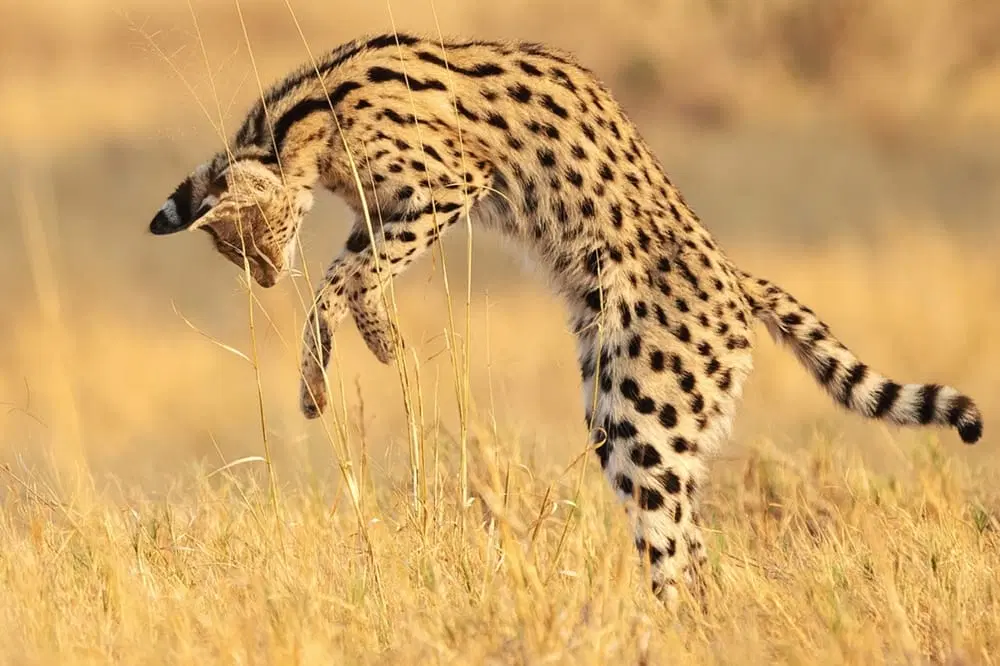
In fact, the serval is easily distinguished from all other cats by its ears – they are unusually large, standing like two houses on the edge of a hill. The serval is also known for its superb hearing – it can even hear rodents moving under the earth. As soon as this predator senses vibration, it uses its sharp claws to quickly dig into the ground. A few seconds, and the prey is in the clutches of the serval. No mouse will hide underground if there is a hungry serval with its huge ears searching for dinner.
Another distinctive feature of the serval is its long, strong legs. Unlike the cheetah, it cannot chase its prey for long periods of time, but the serval can move quickly at short distances. These legs also allow the cat to quickly climb trees and catch tree hyraxes or jump high to knock down a flying bird. Being 60 centimetres tall at the withers, the serval can jump more than 2 meters high! And with a little bit of speed, it can jump 4 meters in length.
You can see these beautiful animals in Africa, south of the Sahara. They were once found in the north of the continent, too, but due to human hunting, they are now an endangered species in North Africa. However, in Central and especially East Africa, the serval is very common; for example, the entire territory of Tanzania is a part of their habitat.